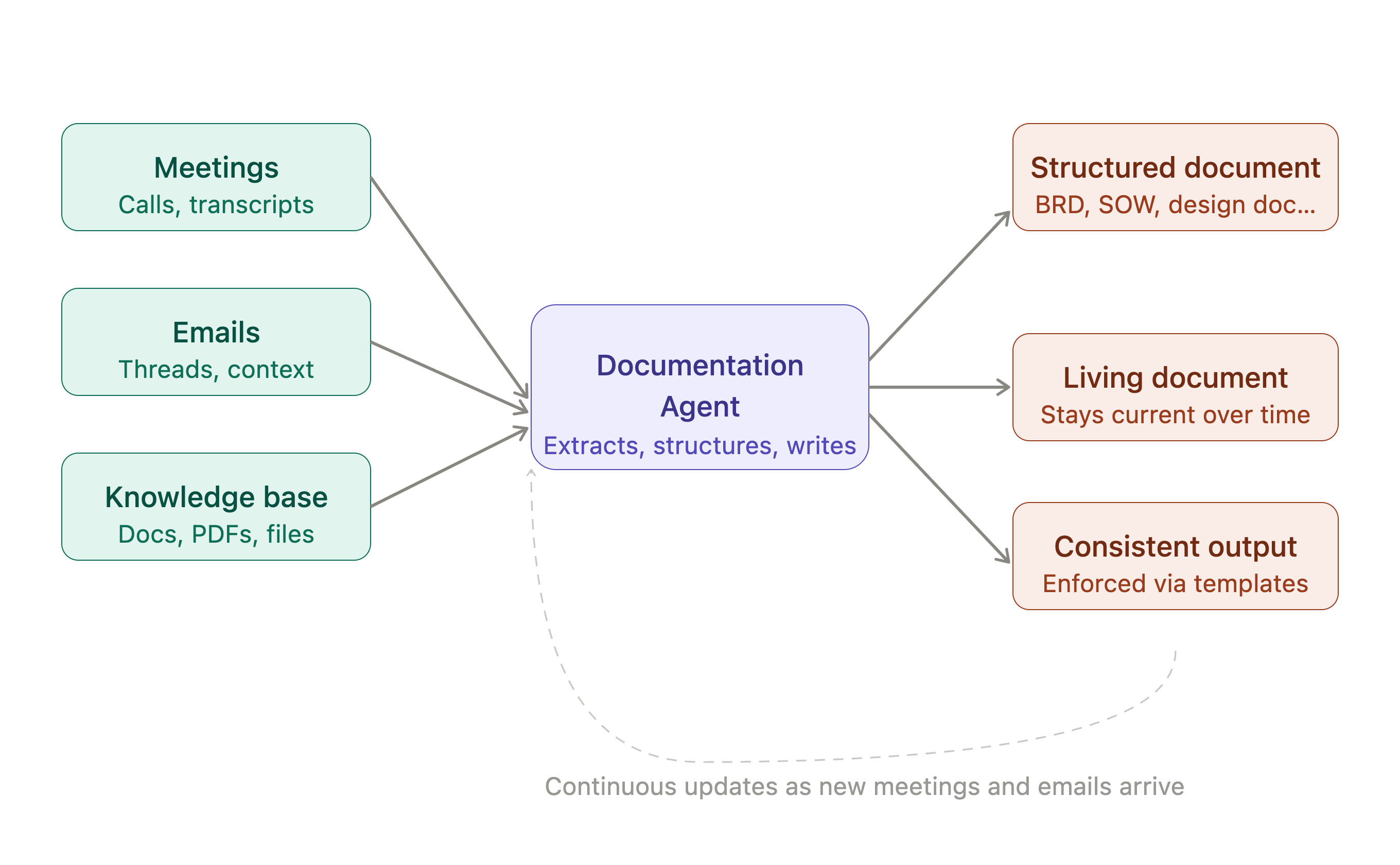
Documentation Agents automatically create structured project documentation by gathering information from the work already happening across a team. They listen to meetings, read through emails, and pull in relevant product or customer knowledge, then convert that input into polished, structured documents.
Documents can also be kept continuously updated. The latest requirements, decisions, and changes from each meeting or email can automatically flow into the correct sections of configured templates, without manual updates.
When to Use
Documentation Agents are useful when there is a need to:
Consolidate information from multiple meetings and email threads into a single structured artifact
Maintain a living document that stays current as new interactions occur
Standardize documentation output across teams by enforcing consistent templates
Reduce manual effort required to write, update, and maintain delivery documentation
What Documentation Agents Can Generate
Documentation Agents can generate a wide range of project and delivery documents, including:
Business Requirements Document (BRD)
Solution Design Document (SDD)
Discovery Notes
Scope of Work (SOW)
Implementation Plan
Hand-off Documents
Data Migration Plan
Integration Design Document
And much more..
Documentation Agents vs AI Fills
Both Documentation Agents and AI Fills use AI, but they operate at different depth and scope.
Use AI Fills for fast meeting-scoped outputs. Use Documentation Agents when complete, durable project documentation is required across multiple sources.